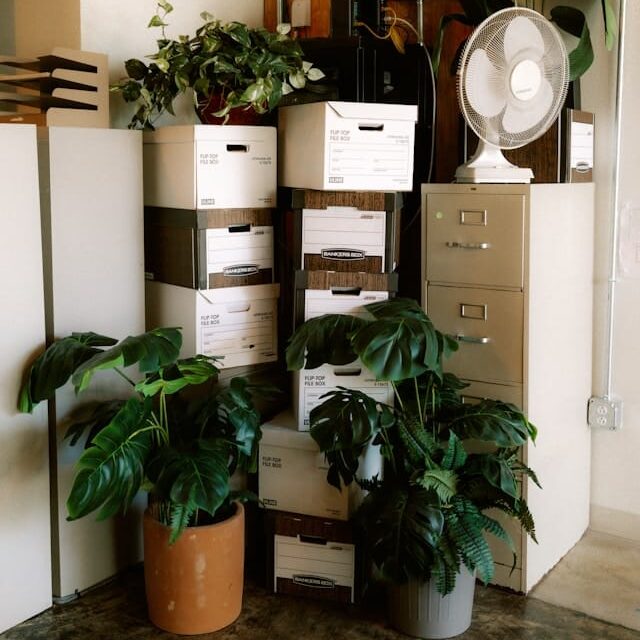
When business records begin taking over valuable office space, organisations generally have three options: move inactive records into secure offsite storage, digitise them, or securely destroy records that have reached the end of their required retention period.
For many businesses, the most practical solution is a combination of all three.
Contracts, financial records, personnel files, client documents and historic paperwork can all need to be retained for years. As these records accumulate, filing cabinets become cupboards, cupboards become storerooms and valuable office space gradually turns into archive storage.
A structured records management strategy can release that space while ensuring important information remains secure and accessible.
Why Do Businesses Accumulate So Many Paper Records?
Businesses accumulate paper records because many documents need to be retained for legal, regulatory, operational or historical reasons, sometimes for many years after they were originally created.
Common examples include:
- Contracts and agreements.
- Financial and accounting records.
- Personnel files.
- Client and customer records.
- Legal files.
- Medical or healthcare records.
- Property documentation.
- Historic business records.
Some original documents may also need to be preserved in their physical form.
As a result, even organisations that now operate predominantly digitally can find themselves responsible for substantial historic paper archives.
What Is the True Cost of Storing Records in an Office?
Storing archive boxes within an office may appear inexpensive, but the business is effectively using commercial floor space as document storage.
Rooms occupied by archive boxes could potentially be used for:
- Additional workstations
- Meeting rooms
- Breakout areas
- Equipment storage
- Business expansion
- More productive working environments
Filing cabinets and archive rooms also occupy space that businesses are already paying to rent, heat, light and maintain.
For records that are rarely accessed, specialist offsite document storage can therefore make better use of both space and resources.
Is It Safe to Store Business Records in an Office?
Business records can be stored onsite, but organisations should ensure appropriate security, access controls and records management procedures are in place.
Documents can contain confidential personal, financial, medical, legal or commercially sensitive information.
Businesses should therefore consider:
- Who can access stored records?
- Is access controlled or monitored?
- Can individual files and boxes be located and tracked?
- Are records protected from fire, water damage and theft?
- Could documents be removed without being recorded?
- Is there a defined retention and destruction process?
A locked cupboard or storeroom provides a degree of protection, but specialist records management facilities are designed specifically for the secure storage and management of business information.
Should a Business Scan All of Its Old Records?
Not necessarily. For organisations with large archives that are rarely accessed, securely storing physical records and scanning documents when required can be more cost-effective than digitising every page.
Bulk document scanning can be extremely useful where records are regularly accessed, need to be shared between locations or form part of a wider digital transformation project.
However, an archive containing hundreds or thousands of boxes can contain millions of individual pages. Digitising everything may involve significant work and expense, particularly where much of the information may never be accessed again.
There may also be records where retaining the original physical document remains important.
The right approach depends on the type of records, how frequently they are accessed and how long they still need to be retained.
What Is Offsite Document Storage?
Offsite document storage is the secure storage of business records at a specialist records management facility rather than within the organisation’s own offices or premises.
Records are typically boxed, indexed and tracked so that they can be located and retrieved when required.
A managed offsite archive can provide:
- Secure records storage
- Box and file tracking
- Controlled access
- Physical document retrieval
- Scan-on-demand retrieval
- Retention management
- Secure destruction when records reach the end of their lifecycle
At L&R Storage, we manage physical business records within dedicated records management facilities across the UK, alongside retrieval, scanning, scan-on-demand and confidential destruction services.
This allows organisations to move inactive records out of expensive office space without losing access to the information they contain.
Will Moving Records Offsite Make Them Harder to Access?
No. A professionally managed archive should allow records to be identified and retrieved when they are needed, either physically or electronically through a scan-on-demand service.
Individual boxes and files can be indexed and tracked within a records management system so their location is known.
This can actually improve access for organisations whose existing archives consist of filing cabinets, storerooms or boxes with inconsistent labelling.
Instead of a member of staff searching manually through an archive room, the required record can be identified and retrieved through a controlled process.
What Is Scan on Demand?
Scan on demand allows a business to keep its physical archive in secure offsite storage while receiving electronic copies of individual documents or files when they are required.
Rather than paying to digitise an entire archive in advance, records remain securely stored in their original format.
When information is needed, the relevant record is retrieved, scanned and supplied electronically.
This can be particularly effective for large, inactive archives where only a small percentage of records are ever requested.
It provides many of the accessibility benefits of digitisation without necessarily requiring the entire archive to be scanned.
When Should a Business Consider Offsite Document Storage?
Businesses should consider offsite document storage when inactive records begin consuming valuable office space, become difficult to manage or cannot be stored securely onsite.
Common warning signs include:
- Archive boxes occupying working areas
- Filing cabinets taking up significant floor space
- Records being stored in unsuitable rooms or buildings
- Staff struggling to locate historic files
- Uncertainty about exactly what records are being retained
- Office expansion being restricted by archive storage
- Records being kept indefinitely because there is no formal retention process
At this point, the issue is no longer simply a shortage of space. It has become a records management problem.
Is Offsite Document Storage Suitable for Confidential Records?
Yes, provided the records management provider has appropriate physical security, information security and operational controls in place.
Organisations considering a storage provider should look at areas including facility security, staff vetting, access controls, records tracking, retrieval procedures, information security standards and secure destruction arrangements.
L&R Storage provides records management services to organisations across sectors including legal, healthcare, education and commercial businesses, with secure storage forming part of a wider records lifecycle that can include scanning, retrieval and confidential destruction.
Storage, Scanning or Destruction: Which Should You Choose?
For many businesses, the most effective records management strategy uses all three.
Store records that must be retained but are rarely accessed.
Scan records that need regular or convenient digital access.
Destroy records securely when there is no longer a legal, regulatory or business requirement to retain them.
The appropriate approach can even vary within the same archive.
Rather than treating every box identically, organisations can identify what needs to remain physical, what would benefit from digitisation and what has reached the end of its required retention period.
This reduces unnecessary storage while ensuring important information remains available.
Managing the Full Lifecycle of Business Records
Effective records management is ultimately about maintaining control of information throughout its lifecycle.
A document may begin as an active business record, move into an archive once it is no longer regularly required, be retrieved or digitised when needed and eventually be securely destroyed once its retention period expires.
L&R Storage provides secure document storage, document scanning, scan-on-demand, retrieval and confidential destruction services for organisations across the UK, helping businesses manage that complete records lifecycle.
Related Services
Secure Document Storage
Store archive boxes safely in our secure UK facilities, with fast retrieval when you need access to your records.
Document Scanning Services
Convert paper records into searchable digital files while reducing the amount of physical storage required.
Confidential Shredding
Dispose of documents securely and compliantly once retention periods have expired.
Wills & Deeds Storage
Specialist storage for original legal documents, deeds and wills.
Running out of room for your business records?
L&R Storage provides secure offsite document storage, scanning and confidential destruction services for organisations across the UK. Whether you’re dealing with a few hundred archive boxes or a substantial historic collection, our team can help you identify the most practical way to store, digitise and manage your records.